| EMC test system for 20-220 MHz,
with 10 kw compact LPA, shown on 2-4 m. adjustable height,
roll-around dielectric crank-up mast. Mast is capable
of polarization change from H to V, and up to 15 deg.
forward tilt . |
 |
EMC test system for 65-220 mHz,
with 5 kw LPA, shown on 2-4 m. crank-up roll-around
dielectric mast with tilt and polarization adjust |
 |
Drive-in E-Field generator for 0.01-20 mHz
@ 10 kw
One of several designs developed at SAS for EMC testing
of vehicles and other devices with susceptible electronics
inside. E-fields in excess of 300 v/m are generated,
and the units are designed to accept 10 kw cw. Air-cooled
resistor banks are used which do not require any other
coolant.
The entire structure is designed for rapid assembly
and disassembly, thus freeing up valuable chamber space
when not in use.
|
 |
| |
|
LOG PERIODIC ARRAYS |
4-16MHz
20 kw Log Periodic Array for OTHR
The unit shown is our SA LPMA4, and operates over 4-16
MHz (useable 3.5-21 MHz) provides up to 12 dBi gain
and handles 20 kw cw power levels. The unit was designed
for OTHR (over-the-horizon radar) use, and is supplied
with an extensive on-earth ground system.
The antenna system is designed to be portable, and can
be set up by a few people in a relatively short time
. Weather protection is included, and 100 mph wind survival
is standard.
SAS has developed HF OTHR antennas, including 10 kw
transmit LPA’s and multiple receive LPA’s
used by the US Navy for early-warning systems. |
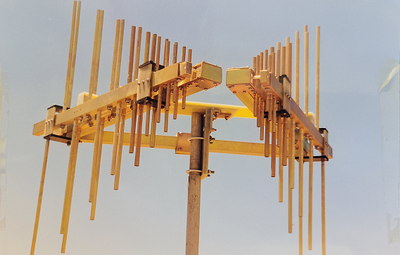
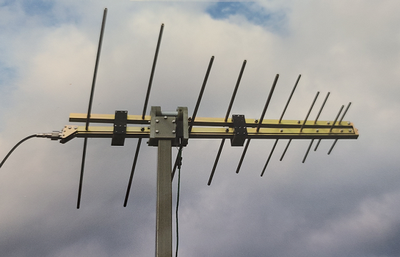
20-150 MHz dual-polarized LPA
A 20-150 MHz model is shown, one of many types developed
. Two feedpoints are provided for the two orthogonal
linear polarizations. A hybrid coupler may also be used
to create circular polarization.
SAS has developed an end-loading system for the lowest-frequency
elements on it’s log periodic arrays, which reduces
element lengths and wind loading without sacrificing
gain.
|
 |
35-150 MHz Rapid-Field-Deploy LPA for Meteor
Bounce
This array operates over 35-150 MHz @ +8 dBi gain, and
was designed for a major Meteor Bounce Program, with many
hundreds of units shipped. Two persons can assemble/disassemble
this antenna within 8 minutes. Folding elements, a two-section
boom, and the SAS end-loading system, along with earth-mounted
installation fixtures all contribute to the ease of use
of this array. |
 |
20-500 MHz Communications LPA
Operating over 20-500 MHz, this antenna also utilizes
the SAS end-loaded element system to reduce size and wind
area. Stabilizer rods made of fiberglass provide inter-element
spacing stability, guaranteeing electrical performance
remains constant under high wind conditions, up to 100
mph. |
 |
OMNDIRECTIONAL ANTENNAS |
| 0.35-7.2 GHz Log Periodic with
swivel mount |
 |
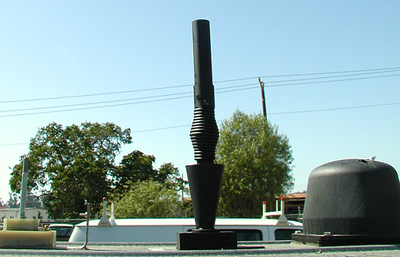
| A new ultra-wide-bandwidth vertical Omni, which covers
300 MHz to 12 GHz (useable to 20 GHz) |
 |
| A new ultra-wide-bandwidth vertical Omni, which covers
820 MHz to 20 GHz ! |
 |
Discone Antennas
A group of 30-400 KHz ground mounted discones is shown
on the right. SAS has developed various discones, including
rapid field deploy types. |
 |
30-90
MHz Rapid Field Deploy OMNI'S
These omnidirectional vertically polarized dipole antennas
exhibit a wide instantaneous bandwidth and high efficiency,
which result from their mechanical design. They are
easily erected in the field, and fit neatly into carrying
bags for transport.
|
20-400
MHz Rapid field-deploy omni’s
This type of conical monopole can cover 20-500 MHz, when
ground mounted and using wire radials or when vehicle-
mounted. The vehicular version is currently in use by
NATO in Europe.
|
30-76 MHz Robust Omni
This extremely rugged biconical dipole was one of the
first antennas ever developed by SAS, and a significant
number of them have provided ground communications from
mountaintop locations at the NTC (National Training
Center) Ft. Irwin, California since 1982. The antenna
is rated for 140 mph wind survival. |
 |
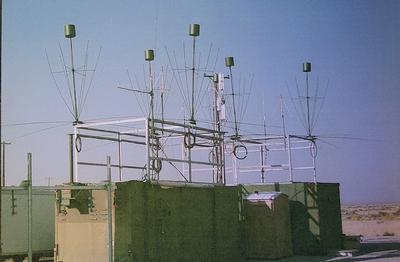
DF Array
SAS has developed many antenna arrays used for Direction
Finding Applications. Shown on the right is a 3-element
2-30 MHz array used by the US Navy. Another DF array covers
20-500 MHz (in three bands) with +/- 2 deg. phase matching. |
 |
225-400 MHz Colinear
A 225-400 MHz two element collinear array is shown on
the right. “Fat” dipoles developed by SAS
are available for frequency ranges up to 2.8 :1.
Specific dipoles and monopoles are available for frequency
ranges of 100-500 MHz, 0.5-1 GHz, and 1-2.5 GHz, and other
frequency bands such as the cellular and ISM bands. |
 |
2-30 MHz Conical Monopole
A field-deployable wideband vertical omni, which
can be erected by two persons in a short time. |
 |
NTC Base Station Antenna
Stacked collinear broadband dipoles are provided
on a common mast. The dipoles are shown installed for
vertical polarization, however the installation kit allows
for horizontal polarization as well.
This type of collinear dipole array is available for many
frequency bands, for instance, the SA V425 designed for
the US Navy, tuned for 400-450 mHz with +4 dBi and 1.5
kw cw power handling . |
 |
AIRCRAFT ANTENNAS |
100-500 MHz Blade Antenna
The SA AM100-3 has been in service on Falcon
and Lear jets since 1983 . The antenna handles 400 +
watts cw, and is used for com-jam applications.
|
 |
20-100 MHz Aircraft Antenna
The SA AM20 is a robust design, capable of
200 + watts power input. The unit has seen service on
large aircraft in com-jam applications.

|
 |
|
|
TEST FACILITIES |
ANECHOIC CHAMBER
An indoor anechoic chamber is used at SAS for most antenna
measurements in the frequency range 0.45-6 GHz. Outdoor
test facilities include an open- field site in Watsonville,
CA and an 11 acre site in the Sierra foothills near
Sacramento, CA. |
 |